

Derby and District Astronomical Society
The Sun in 2025
[Gallery]
| Chris Callaway took the following two images of sunspot group 4191 on the 26th August 2025. The top image was taken in white light and was created from the best 87 frames of a 2000 frame video at a frame capture rate of 162 frames per second. Chris used an 8" Meade LX 200 protected with a solar film filter, ZWO ASI462MM camera with UV/IR cut filter and a Celestron AVX mount. The bottom image was taken in hydrogen alpha light from the best 103 frames of a 3000 frame video using a Coronado SolarMax II telescope, a ZWO ASI462MM camera with a UV/IR cut filter and ZWO tilt adjuster and a Celestron AVX mount. It is interesting to compare the white light and hydrogen alpha images. The white light image is showing the features on the visible surface of the sun (the photosphere) whereas the hydrogen alpha image is showing the features on the layer of the sun's atmosphere directly above the photosphere (the chromosphere). Image Credit: Chris Callaway. |
|
|
|
|
| This image of sun spot group 4172 was created by Chris Callaway from data gathered on the 15th August 2025. Chris used a Coronado 90, ZWO 462MM camera fitted with an Optolong UV/IR cut filter, ZWO tilt adjuster, Tele Vue 2.5x Powermate and a Celestron AVX mount. The image comprises the best 200 frames from a 3000 frame video file. Image Credit: Chris Callaway. |
 |
| Pete Hill captured this image of the Sun in H alpha on the 12th July 2025. Pete used a Coronado PST on an HEQ5 pro mount, solar tracking, and a DMK41 mono CCD camera. Images of the disk and prominences were taken separately, using 1000 frames each and then processed in Autostakkert2, with the best 500 frames stacked. The images were tweaked using wavelets in Registax 6, and the final processing, merging and colourising of the layers performed in Photoshop CS6. Image Credit: Pete Hill. |
 |
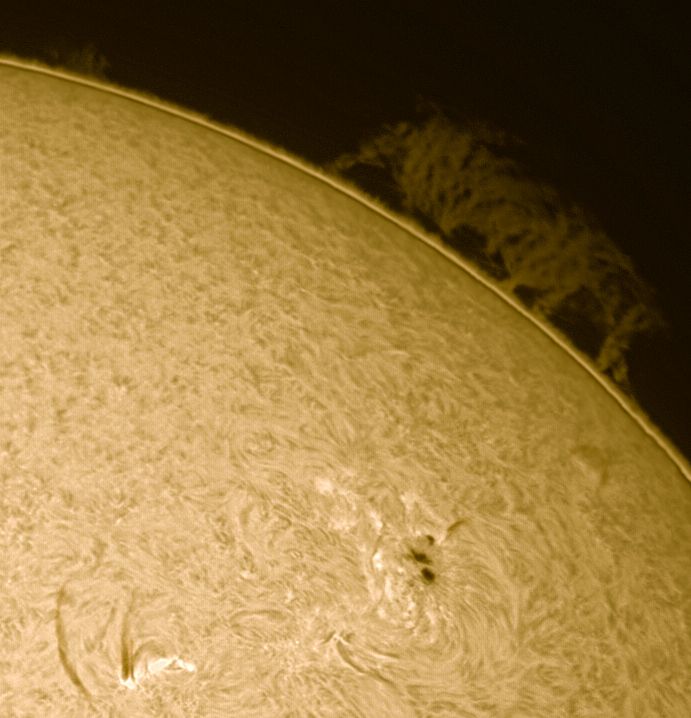
| The data for the following image of the Sun was captured by Chris Callaway on the 11th July 2025. Chris used a Coronado 90, ZWO ASI462MM camera and ZWO T2 tilt adjuster. The video comprised 6000 frames shot at 148 FPS. The best 169 frames were stacked. Both positive and negative versions of the image are shown. Image Credit: Chris Callaway. |
 |
 |
| On the 4th February 2025 Tony Razzell captured a couple of M class solar flares using his Very Low Frequency Sudden Ionospheric Detection system (described here). One M4.7 class flare occurred at 11:20 am and one M3.2 class flare (or possibly more than one concurrently as the shape is slightly different with a slower build-up) at around 13:10-13:14 pm. The GOES-16 satellite's X-Ray flux data is also shown for comparison. |
 |

|
| Neil Garside captured this image of the Sun on the 2nd February 2025 using a Seestar S50 and Baader solar filter. Neil comments that the Baader filter appears to give much finer details than the stock filter that comes with the Seestar. Image Credit: Neil Garside. |

|
[Top]